I made Held While Letting Go as a daily prayer against pain — my grief, the suffering of those I love, and the long endurance of witnessing what cannot be fixed. This work does not attempt to resolve suffering. It exists to stand with it, to lift what can be lifted, and to remain present when relief is not possible.
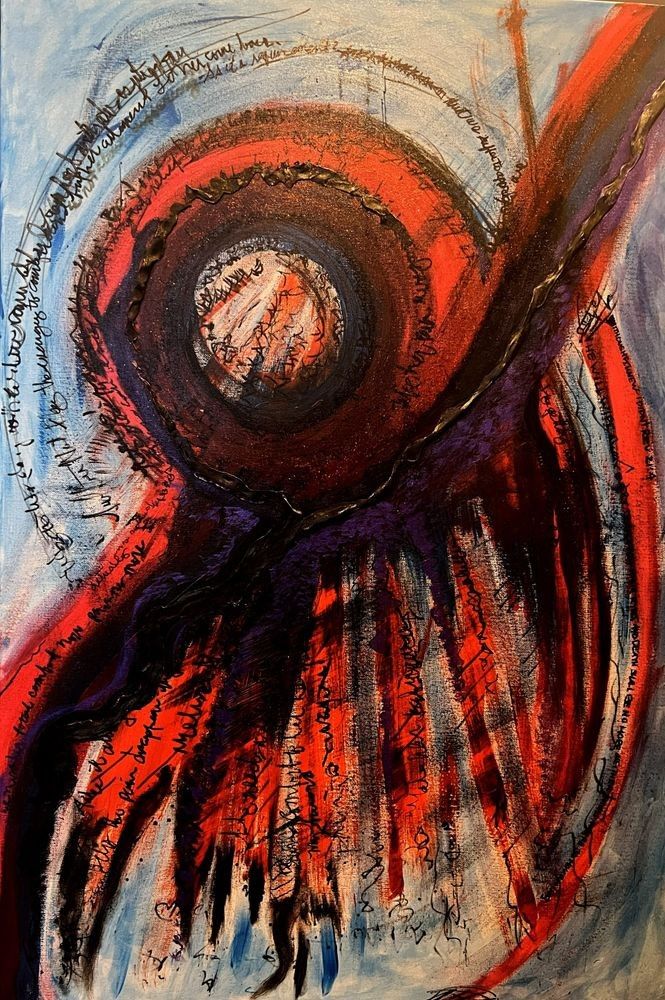
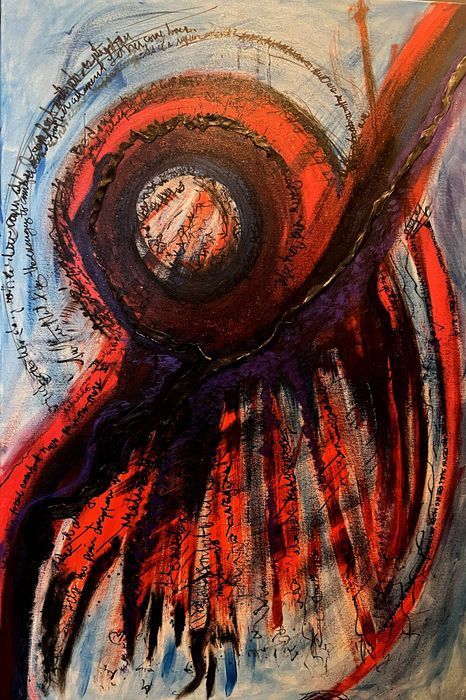
At the center of the piece, a sculpted soul‑form rises from the surface, bound by a spiral that glows red under ultraviolet light. I understand this spiral as a knot — formed by love, pain, and responsibility. Under changing light, the knot does not disappear, but it loosens. Its tension eases. What was tightly held is allowed a small measure of breath.
This painting functions as a talisman. Each day, it acts to lift the weight of grief and to stand against the suffering of someone deeply loved who is still alive, still enduring. I made it in recognition of the humility required to love without the power to heal, rescue, or fully understand another’s pain. What shifts here is not love or care, but the grip — the tightening that comes from trying to carry what cannot be carried alone.
The work is spiritually grounded through my integration of a passage from the Book of Revelation that speaks to the tenderness of divine attention — the assurance that sorrow is seen, that tears are noticed, and that pain is not overlooked. I do not treat this promise as an ending, but as a presence that exists alongside suffering. The painting does not claim that pain has ceased; it affirms that pain is not abandoned.
Color and texture trace the internal movement of this prayer: red for endurance and truth, black for boundary and holding, white for breath, purple for transformation, and blue for comfort — some visible only when the light changes. These layers reflect the daily nature of the work itself, returning again and again to the same posture of care.
This piece exists alongside Shattered: Held from Above, which centers my own mourning and the experience of being held through loss. Held While Letting Go shifts the orientation outward — toward witnessing, toward trust, and toward the recognition that those who suffer are not alone, even when their pain continues.
The knot remains.
But it loosens.
Each day, the work lifts what it can.
Each day, it eases the strain.
Each day, it keeps watch.
That is the work.